


KG ↔ LBS Conversion Calculator
Convert between kilograms (kg) and pounds (lbs).
Formula: 1 kg ≈ 2.20462 lbs.
Kilograms to Pounds
Example: 20 kg ≈ 44.09 lbs.
Result: –
Pounds to Kilograms
Example: 44.09 lbs ≈ 20 kg.
Result: –
Introduction
KG to LBS Conversion Calculator
To convert kg to lbs, you need to know how many pounds equal one kilogram and then perform the calculation. This online calculator helps you quickly and accurately convert between these two weight units.
KG to LBS Formula Explained With Examples
As 1 kg = 2.20462 lb, then
LBS = kg x 2.20462
You can multiply kg by 2.20462 to calculate weight in pounds. People can know how to convert kilograms to pounds even if they do not have to depend on charts outside.
19-inch forged car wheel is 9.2 kg, and its equivalent in pounds is
9.2 kg x 2.20462 = 20.28 lbs.
This makes using a kilogram to pound formula with examples to find equivalence by multiplying the number of kilograms by 2.2046, also the user will make no errors. Inaccuracies that do not decrease can be reduced. It is easier to know the error in their weight conversion.
KG to LBS Chart
A compact comparison chart helps immensely while checking the weight of the rims and tyres. As well as long datasets are tough to scroll through and compare each value mentioned. This kg to lbs chart gives the values mostly used in passenger cars, performance builds, and lightweight alloy applications.
| Kilograms (kg) | Pounds (lbs) | Common Application |
|---|---|---|
| 6 kg | 13.23 lbs | Small car tire (13-15 in) |
| 7 kg | 15.43 lbs | Lightweight forged wheel |
| 8.5 kg | 18.74 lbs | Racing slick tire |
| 10 kg | 22.05 lbs | Standard car tire (16-17 in) |
| 12 kg | 26.46 lbs | Performance tire |
| 15 kg | 33.07 lbs | Cast alloy wheel (18 in) |
Convert 8 kg to LBS
1 kg = 2.20462 lb
8 kg x 2.20462 = 17.63696 LBS
Convert 12 kg to LBS
1 kg = 2.20462 lb
12 kg x 2.20462 = 26.45544 LBS
Convert 15 kg to LBS
1 kg = 2.20462 lb
15 kg x 2.20462 = 33.0693 LBS
KG to LBS Conversion Calculator: How Much Does a Tire Weigh and Why Rim Weight Matters
Anyone who owns, works on, or modifies cars needs to understand wheel and tire weight. It affects steering, cup use, stopping distance, and suspension force. The KG to LBS Conversion Calculator is important when comparing rims, tires, and other aftermarket upgrades. Here’s why. Many people are also searching for the weight of the tire when choosing replacements. Some search when switching to alloy. Others do so when going for forged or flow-formed wheels. Kipardo accurately weighs the setup so customers can select the right one. Also, it doesn’t compromise safety or performance.
Why Do Car Owners Need a KG ↔ LBS Calculator?
According to a previous study, this is because rim manufacturers typically list weights in kilograms, compared to tire distributors in North America who rely on pounds. Therefore, it creates a headache for customers when comparing international products while they are purchasing. When you convert KG to LBS, you can only find comfortable results. It also helps your buyer to check the wheel and tire weight and make sure you are purchasing to desired wheel set. Because the weight of a wheel set can dramatically affect the response of acceleration, increase the distance to stop, and the load on the components of the suspension.
How Much Does a Tire Weigh? Complete Tire Weight Breakdown
Many drivers may find themselves asking just how much does a tire weighs, and that is not out of mere curiosity. The weight of tires depends on the design and load capacity as well as the compound used, and each one behaves differently during real driving. The carcass thickness, bead strength, tread depth, and reinforcement layers are some of the considerations of engineers, which add to or reduce the weight. By knowing the difference between domestic tires (LDP) and regional tires (LRC), buyers can select the right tire for their vehicle type and driving style. This is especially helpful when comparing the two similar options with cross-regional specifications.
1. Average Car Tire Weight
Most passenger car tires fall within a moderate range. The smaller compact-car tires have less weight due to narrower width and thinner walls, while touring tires are heavier as they offer extra layers for better comfort and more durability. The final weight of the tyre is also affected by speed rating, ply strength, and internal belt design.
2. SUV & Truck Weight (tire)
SUV and light truck tyres are made to bear heavier loads and handle the stress of going off–road. This means they are heavier than the typical car tyre. The heavy construction of these tyres may increase the tyre’s weight. Moreover, the large–diameter and reinforced sidewalls of these tyres add to the weight. When these tyres are designated with an added load–range reinforcement, they carry even more weight. However, their weights are reasonable, especially if you see them in all–terrain or highway–terrain categories.
3. Performance, Racing, and Off-Road Weight (Tire)
High–performance or racing tyres use a special rubber compound and a layer of belts, designed to maintain longer stability at higher speeds. This contributes to added weight. An off–road tyre has more weight because of its aggressive tread blocks and its bead–locking structure.
The design priorities of grip, durability, and heat resistance affect the overall weight.
4. Tire Weight Chart
This automotive-specific tire weight chart:
| Tire Category | Typical Weight Range |
| Small car tire (13–15 in) | 6–9 kg |
| Standard car tire (16–17 in) | 8–12 kg |
| Large sedan tire (18–19 in) | 10–14 kg |
| Compact SUV tire (17–18 in) | 12–16 kg |
| Mid-size SUV tire (18–20 in) | 14–20 kg |
| Light truck tire | 17–25 kg |
| All-terrain tire | 18–28 kg |
| Mud-terrain/off-road tire | 22–35 kg |
| Performance tire | 9–14 kg |
| Racing slick | 8–12 kg |
How Heavy Are Rims? (Cast, Alloy, Forged & Flow-Form)
There are various criteria to determine the rim weight of your vehicle. As you know, different manufacturing methods produce low-weight, high-density, unique structures and specific load capabilities. Differentiating in-between them helps you to know how much does a rim weighs using a KG to LBS Conversion Calculator, also helps to understand the method of your vehicle manufacturing. The thickness of material, barrel design, and forged pressure influence wheel rim weight. Different categories perform different purposes on the road.
1 Cast Alloy Wheels
The weight of the cast wheel is more than the other type of alloy wheel because it includes pouring molten aluminum into molds without further strengthening. The cast wheels are used in replicas to entry-level aftermarket wheels. It is the thicker section that provides the sleek, deep look of alloy wheels.

2 Flow-Form Alloy Wheels
The wheel is rotary, forming the flow that stretches and composes the barrel. The so-formed structure is thinner and 10-20% lighter than a typical shape. It can be the greatest combination of quality, cost, and weight a daily driver can have on their vehicle when desiring a nominal decrease in unsprung mass.

3 Forged Monoblock Wheels
Forged monoblocks come from pressing a single aluminum block under extreme pressure to give the best, lightest wheel design for a consumer in the market. They carry the lightest mass to enhance the agility of performance cars and minimize the rotational resistance. For example, at Kipardo, the Kipardo KF19 Forged Monoblock 19×8.5 wheels contribute to reducing the unsprung weight compared to many models.
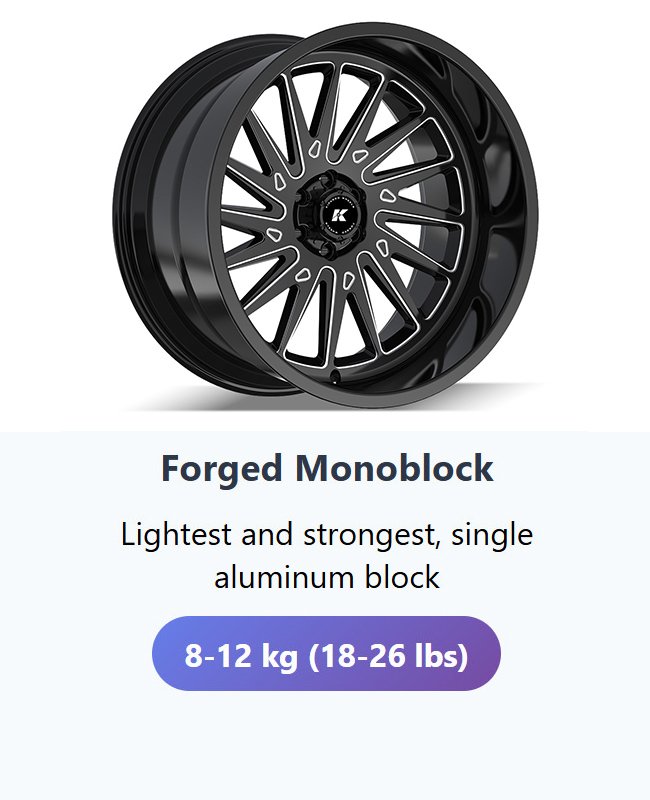
4 Multi-Piece Forged Wheels (2-Piece, 3-Piece)
Split rims are generally multi-piece forgings set, utilising separate centres that can be assembled to make up a complete wheel. They are pretty much the only type of wheel to be “tailored” to your automobile correctly. By calling for a stud on the barrel to hold the various segments collectively, these styles of wheels are both weightier than monoblocks.

Case Study: Why Rim Weight is Important on the Road
Most drivers simply decide on wheels based on design while choosing a new set of wheels, but the actual performance difference only arises once the weight of the rim changes. Less mass calling on the rotating component to supply low energy to set the wheel in motion or bring it to a stop. It also directly affects acceleration and braking distance. Heavier rims demand more energy to start moving and stopping. As soon as a driver changes his/her heavier cast 20-inch wheels in favor of the lighter forged 20-inch wheels, so could notice a huge improvement. As rotational weight stems from the rotating assets, this depicts that every kilogram of weight added or removed is amplified when we discuss how much does a wheel weight. Lighter wheels will automatically put less strain on both dampers and bushings, giving the suspension a wider range to work. Cascade Motors offers a vast choice of the best tyres and allows all clients to check monthly tyre specials when in need.
| Wheel Type | Example Size | Weight | Driving Result |
| Cast Alloy | 18×8 | -Heaviest | -Stable but slower throttle response |
| Flow-Form | 19×8.5 | -Mid-Light | -Better handling and reduced load |
| Forged Monoblock | 20×9 | -Lightest | -Improved acceleration, braking efficiency, and steering response |
Tire + Rim Combined Weight:
Tire rim weight and its combined effect significantly contribute to the fact that the four corners of a vehicle play a subtle role in how it adds to the handling. To say it explicitly, tire with rim weight and combined weight create both rotating mass and unsprung mass, which in turn contribute to the tire and rim’s final cornering stability, stopping power, fuel efficiency, launch acceleration, etc.


The KG to LBS Conversion Calculator gives drivers a much better idea of what the complete assembly weighed exactly and allows us to make pretty close approximations with other wheel types. For example, a tire weighed 11 kg, which is (24.25 lbs) when multiplied by 2.2, and then a rim of 9 kg (19.84 lbs), when multiplied by 2.2, converges to 43.05 lbs. Or 11 kg (24.25 lbs) and 9 kg (19.84 lbs) give a total rotating assembly weight of 44.09 lbs. Buyers must know these facts to select setups that handle well and cause the minimum rocker panel or suspension damage, and above all, keep you and others safe.
Common Conversion Mistakes Car Owners Make
Most motorists make mistakes when converting wheel and tire weights. People usually commit the blunders of combining the weight of the wheel alone with the weight of the tire and rim, or by comparing cast wheel weights with forged wheels without converting units. They also apply the wrong factors in the formula for the weight of tyres and rims. Failing to consider the width of the tyre, sidewall, and Offsets can also lead to incorrect results when converting the wheel and tire weights. The KG to LBS Conversion Calculator tools can be used to convert wheel and tire weights accurately and without any errors.
Conclusion
To understand and know the weight of a tire, it is essential to have an exact weight conversion. It should be done by calculating how much a tire costs and selecting the right rims and tires. It is necessary to have an accurate conversion using a KG to LBS Conversion Calculator is integral to the handling, braking, acceleration, and suspension of a vehicle. By evaluating both tyres and rim mass, you can select the Kipardo rim from their catalog for the right setup for safety and efficiency for a vehicle. There are the best cast, flow form wheels, and forged wheels through Kipardo that are lightweight for each vehicle to attain the most.
Frequently Asked Questions
How many pounds are in one kilogram?
Almost 2.20462 pounds, when you use an accurate Kipardo KG to LBS Conversion Calculator.

